
Lime versus gypsum isn't a quality contest; it's a compatibility one. Across hundreds of Bristol and Bath jobs, the clear pattern is that almost every damp or blown-plaster callout in an older home traces back to gypsum applied to a solid wall that needed lime.
It's Not Which Is Better — It's Which Suits Your Wall
Gypsum plaster and lime plaster are both useful materials. Neither is universally better.
Gypsum is usually the sensible choice for a dry, modern cavity wall or blockwork property. It sets quickly, costs less and produces the smooth, hard finish most homeowners expect from a standard internal skim.
Lime plaster is usually the right choice for a pre-1920 solid-wall property, particularly where the building has a history of damp. It is breathable, flexible and able to accommodate the small movements and moisture transfer that are normal in older brick and stone walls.
The mistake is treating plaster as a product choice before checking the wall beneath it. The same gypsum finish that performs well in a modern house can trap moisture in a Victorian terrace.
| What people assume | What actually decides it |
|---|---|
| Lime is always better because it is traditional. | Lime suits breathable solid walls; it can be unnecessary expense on a dry modern cavity wall. |
| Gypsum is always better because it is harder, faster and cheaper. | Gypsum suits dry modern construction but can fail when applied to a damp solid wall. |
| Damp proves the plaster was poor quality. | Damp may show that the plaster was incompatible with the wall. |
| The right answer is the most expensive material. | The right answer is the material that matches the wall construction and damp history. |
At Gents Venetian Plastering & Rendering, we work with both lime and gypsum every day across Bristol and Bath. The advice starts with the building, not with a preference for one material. For background on how modern, less-breathable materials can alter moisture movement in older buildings, see our guide to avoiding damp and mould behind insulated plasterboard.
The One Question That Decides It — What Is Your Wall Built From?
The question we tell customers to ask is simple: what is your wall built from?
That matters more than whether lime or gypsum has the better reputation. Use this practical checklist before deciding on plaster.
1. Check the age of the property
A house built before roughly 1920 is more likely to have solid brick or stone walls. This is not an absolute rule, but it is a useful first warning sign in Bristol's Victorian and Edwardian terraces, including areas such as Clifton, Redland, Bedminster and Easton.
Later properties are more likely to have cavity walls, although extensions and alterations can create a mixture of wall types within the same house.
2. Look at the wall thickness
Measure the thickness at a window or door opening if one is accessible. A wall that appears to be roughly one brick thick, with no visible gap, is more likely to be solid. A substantially thicker wall may contain a cavity, but thickness alone cannot prove it.
External brick patterns can also help. Older solid brickwork often shows bricks running through the full wall depth, while cavity construction has an inner and outer leaf separated by a gap.
3. Establish whether there is a cavity
A cavity wall has two leaves with an air gap between them. A solid wall does not. A borescope inspection, a small inspection hole or evidence from an existing opening may confirm the construction more reliably than guesswork.
Do not assume that a modern-looking plaster finish means the wall is modern. Many older solid walls have been repeatedly patched, skimmed or painted, hiding the original construction.
4. Identify the material: brick, stone or blockwork
Solid brick and stone walls in period properties usually need a finish that can manage moisture. Modern blockwork may be suitable for gypsum, particularly when it is dry and protected from penetrating damp.
The substrate still needs checking. A gypsum skim over an unsuitable or damp background will not become appropriate simply because the surface looks flat.
5. Ask about damp history
Look for salt deposits, staining, bubbling paint, crumbling plaster, musty smells or areas where the plaster sounds hollow when tapped. These signs do not automatically prove that lime is required, because leaks, rising damp, penetrating damp and condensation need different solutions.
They do show that the wall should be investigated before it is sealed with a hard, non-breathable finish. Internal wall insulation and plaster systems can change where condensation occurs, which is why the wall build-up matters as much as the visible surface.
If you are unsure, a plasterer should inspect the wall, identify the likely moisture source and check whether previous coatings are contributing to the problem. It is better to establish the construction first than to pay for a finish that has to be removed later.
Gypsum Plaster — What It's Good At (and Where It Fails)
Gypsum is a manufactured plaster based on calcium sulphate. Products such as Thistle Multi-Finish are widely used for internal skimming and provide a consistent, smooth surface.
Where gypsum works well
Gypsum is a strong option for:
- Dry modern cavity walls
- Modern blockwork and plasterboard systems designed for gypsum finishes
- Standard room skims and repairs where the background is sound
- Projects with tight programme requirements
- Homeowners wanting a very smooth, hard surface at a lower material and labour cost
It has a fast set and can often be ready for mist coating and decoration within days, depending on thickness, ventilation and the rest of the wall build-up. Its consistency also makes it efficient for larger areas.
Where gypsum fails
Gypsum is not breathable in the way lime plaster is. On a solid brick or stone wall, particularly one that takes in and releases moisture, that can create a serious compatibility problem.
The gypsum layer may restrict evaporation. Moisture and salts then build up behind or within the plaster, causing staining, powdering, cracking or blown plaster. Gypsum can also be too rigid for the movement found in some old buildings, so cracks may develop where a more flexible finish would have accommodated the movement.
That does not make gypsum a bad plaster. It means gypsum should not be used automatically on a period solid wall simply because it is quicker or cheaper.
For technical background on the value of breathable materials in older buildings, Historic England's guidance on maintaining older houses is a useful starting point.

Lime Plaster — What It's Good At (and What It Costs)
Lime plaster is made using lime, aggregate and water. Traditional systems may use lime putty, while hydraulic lime sets partly through a reaction with water and can be selected where a different level of early strength or moisture exposure is required.
The correct lime system depends on the wall, exposure, background and finish. Lime putty and hydraulic lime are not interchangeable products for every situation.
Why lime suits older solid walls
Lime plaster is breathable. It allows moisture vapour to move through the wall and evaporate rather than forcing it to find a route around an impermeable coating. It is also more flexible than gypsum and can accommodate the modest movement common in period properties.
Lime slowly carbonates as it cures, returning towards a stone-like calcium carbonate material. Properly applied lime plaster can age well and can be repaired locally without making the entire wall look new and artificially rigid.
Its softer, often more textured appearance also suits the character of older brick, stone and lath backgrounds. It is not a cure for every damp problem, but it is less likely to obstruct a wall's normal moisture behaviour when the system is correctly specified.
The genuine disadvantages
Lime is not a universal upgrade. It costs more because the material, preparation and labour are more demanding. It may require several coats, careful control of suction and appropriate curing conditions.
Its cure time is measured in weeks rather than simply days. Lime must be protected from rapid drying, frost and unsuitable heat, and decoration usually needs to wait until the plaster has adequately cured. The work also requires a plasterer who understands carbonation, coat compatibility and the particular lime product being used.
That extra time and skill are justified on a solid-wall period property. On a dry modern cavity wall, however, specifying lime can add cost and delay without solving a problem that exists.
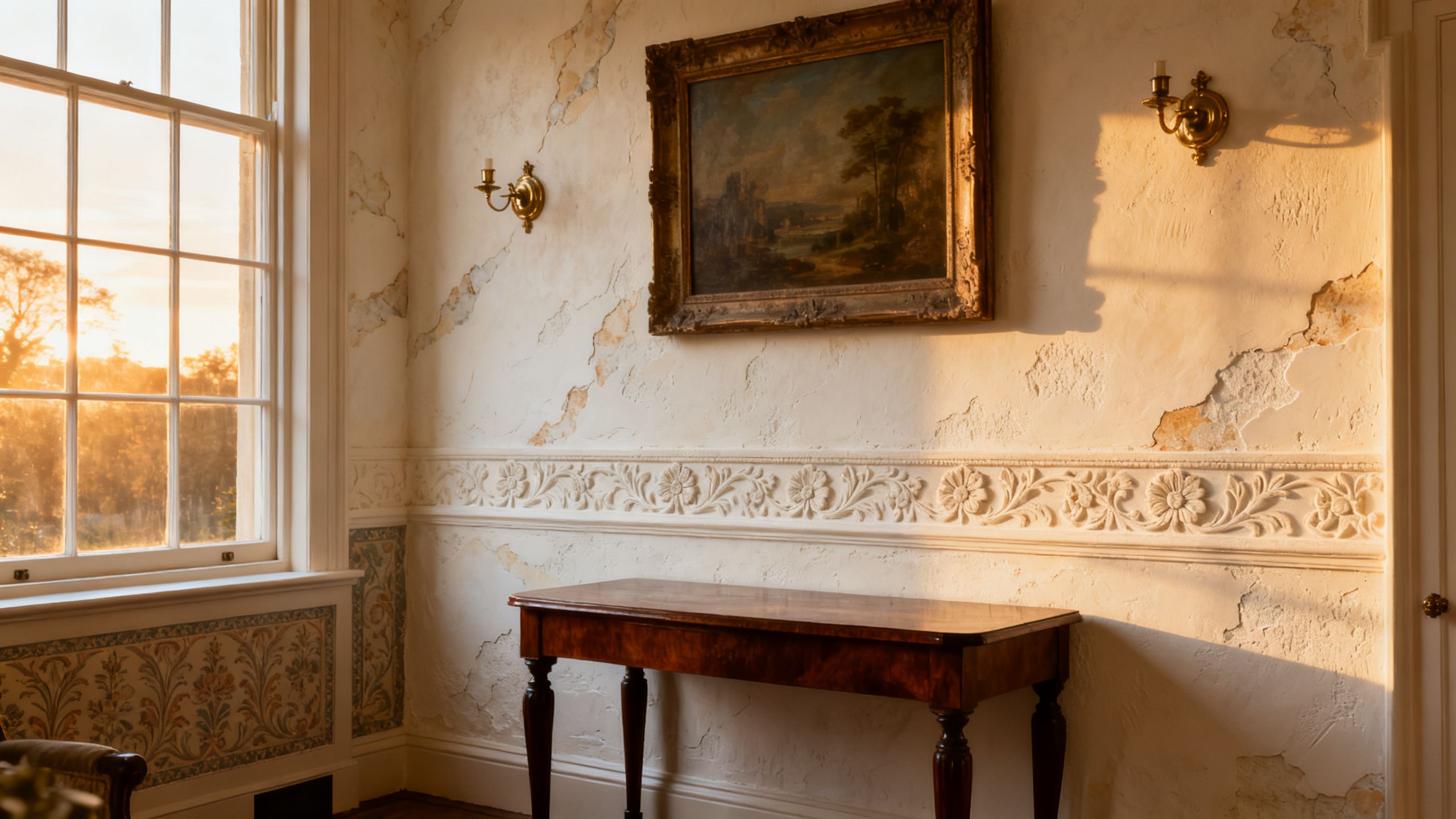
The Mistake Behind Most Damp Callouts We Attend
The most common and expensive mistake we see is gypsum plaster applied to a solid-wall period property because it is cheaper, faster and familiar.
On a modern dry cavity wall, gypsum may perform perfectly. On an older solid wall, its low breathability can interfere with the way the wall releases moisture. The sequence often looks like this:
- A solid brick or stone wall takes in moisture from rain, ground conditions, plumbing leaks or internal humidity.
- Gypsum is applied as a hard, relatively impermeable finish.
- Moisture and salts struggle to evaporate through the surface.
- Damp marks, salt deposits and softening develop.
- The plaster loses its bond and becomes blown or hollow.
- The area is patched or redecorated, but the underlying incompatibility remains.
This is why so many local damp and blown-plaster callouts appear to have the same root cause. The plaster was not necessarily badly made or badly applied. It was the wrong plaster for that wall.
The reverse mistake is less damaging but still wasteful: specifying lime on a modern dry wall without a construction or moisture reason. That can mean more labour, longer drying and a higher bill for no practical benefit.
Before replacing damaged plaster, the cause of the moisture needs to be identified. A failed gutter, leaking pipe, defective pointing or high internal humidity will not be solved by changing plaster alone. Our information on plastering over existing tiled surfaces also illustrates the wider principle: the condition and suitability of the background need checking before a new finish is applied.
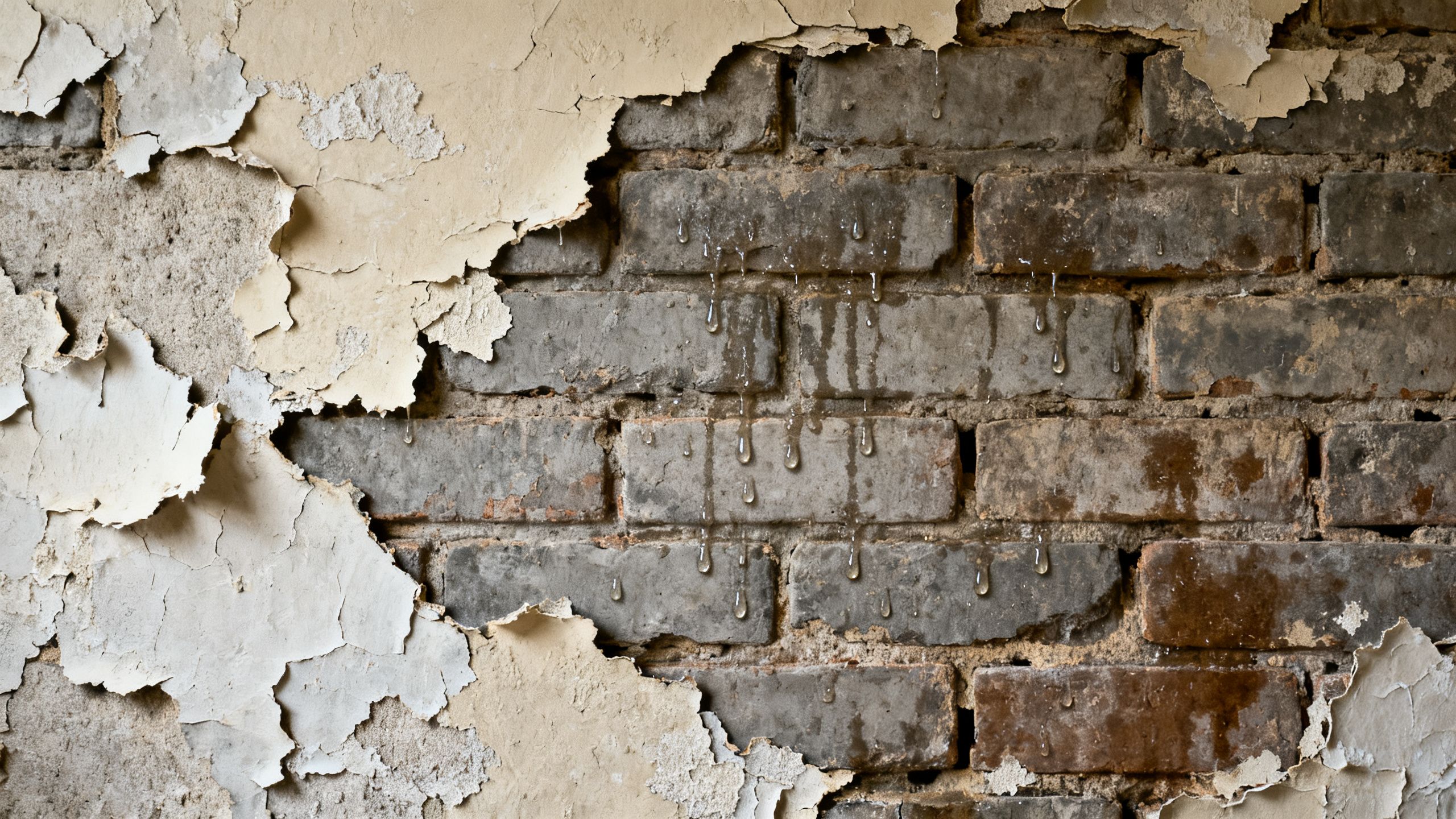
Cost, Drying and Finish Compared
The price difference between lime and gypsum is real, but it reflects the materials, labour and programme rather than one being inherently superior.
| Factor | Gypsum Plaster | Lime Plaster |
|---|---|---|
| Typical cost | Usually cheaper in material and labour | Usually more expensive because it is slower, more skilled and may require more coats |
| Set or cure time | Sets quickly and may be ready for decoration within days | Cures and carbonates slowly, often over several weeks |
| Breathability | Low; generally suitable for dry modern construction | High; generally suited to solid brick and stone period walls |
| Finish | Smooth, hard and modern | Softer, traditional and often more textured |
| Movement | Can crack where an old building moves | More flexible and better able to accommodate minor movement |
| Best application | Dry modern cavity wall, blockwork or standard skim | Breathable solid-wall period property, subject to proper assessment |
| Main risk | Trapping moisture in an unsuitable solid wall | Added cost or delay where lime is not needed |
There are also cost drivers beyond the plaster itself. Removing failed gypsum, drying a damp wall, repairing salts, replacing damaged substrate and redecorating can cost considerably more than choosing the compatible material at the start.
If you want the wall assessed before choosing a system, contact Gents Venetian Plastering & Rendering for a plastering quote. The linked guidance also explains why testing and assessing an existing ceiling or coating before covering it is often more cost-effective than assuming the visible surface tells the whole story.
FAQ
What is the difference between lime and gypsum plaster?
Gypsum plaster is a fast-setting, hard and relatively non-breathable material commonly used on dry modern walls. Lime plaster is slower to cure, more flexible and breathable, making it better suited to many solid brick or stone period walls.
The choice is not about which material is higher quality. It is about whether the material is compatible with the wall's construction, movement and moisture behaviour.
Is lime plaster better than gypsum?
No. Lime plaster is better suited to many pre-1920 solid-wall properties, especially where there is a history of damp or movement. Gypsum is usually better suited to dry modern cavity walls and standard contemporary skimming.
The most important finding from our Bristol and Bath work is that lime versus gypsum is a compatibility question, not a quality contest.
Can I use gypsum plaster on a solid wall?
It is not normally the safe default for an older solid brick or stone wall. Gypsum may restrict moisture movement and can contribute to damp, salts and blown plaster if the wall needs to breathe.
There may be specific situations where a gypsum-based repair is appropriate, but the wall construction, moisture source and existing materials should be assessed first. We would not recommend automatically using gypsum on a solid-wall period property.
Why does gypsum plaster cause damp in old houses?
Gypsum does not create water, but its low breathability can trap or redirect moisture in an old solid wall. That moisture may carry salts into the plaster, causing staining, powdering and loss of adhesion.
The underlying damp can also come from leaking gutters, defective pointing, plumbing or condensation. Gypsum is often part of the failure because it prevents the wall from releasing moisture effectively, rather than being the original source of the water.
Is lime plaster more expensive than gypsum?
Usually, yes. Lime material can cost more, application may involve additional coats, and the work requires greater skill and patience. The wall may also need longer before it can be decorated.
That extra expense can be worthwhile on a solid-wall period property because it reduces the risk of removing and replacing incompatible plaster later. On a dry modern wall, lime may simply be unnecessary extra cost.
How long does lime plaster take to dry?
Lime plaster generally cures over weeks rather than being ready in a few days. Exact timing depends on the number and thickness of coats, ventilation, temperature, humidity, the background and whether lime putty or hydraulic lime has been used.
It must not be forced dry with excessive heat or strong airflow. Rushing the cure can damage the finish and interfere with carbonation. A plasterer should give a project-specific drying and decorating timetable.
What plaster should I use on a Victorian house?
Many Victorian houses have solid brick or stone walls, so lime plaster is often the appropriate starting point. This is particularly true where there is damp, salt contamination, old-building movement or an existing breathable lime system.
However, Victorian properties can contain later extensions, cavity walls and modern repairs. Check each wall rather than assuming the entire house has one construction. The age of the property is a useful warning sign, not a complete specification.
Can you put gypsum over lime plaster?
It is not something to do automatically. Existing lime plaster may be sound, breathable and worth retaining. Covering it with gypsum can restrict its moisture movement and create a compatibility problem.
If the lime is loose or badly damaged, it may need careful removal or repair. The background, damp history and intended finish should be assessed before choosing a replacement. A sound lime surface should not be covered merely because gypsum is faster.
Does lime plaster crack like gypsum?
Lime can crack, particularly if it dries too quickly, is applied to an unsuitable background, is mixed incorrectly or the building moves substantially. It is not crack-proof.
It is generally more flexible than gypsum and can accommodate normal minor movement in an older building more effectively. Good preparation, appropriate coats and proper curing matter just as much as the material choice.
How do I know if my house has solid or cavity walls?
Start with the age of the property, then inspect the wall thickness at an opening. A pre-1920 Bristol terrace is more likely to have solid walls, while many later homes have cavity construction. Check whether the wall appears to be solid brick or stone, or modern blockwork with a cavity.
A visible gap at an opening, a cavity inspection, a borescope or information from building records can provide stronger evidence. Also check for a history of damp, salts or blown plaster. As we tell customers, the deciding question is what the wall is built from; establishing that is more useful than choosing plaster by price or reputation.