
Spray cork is usually priced per square metre, with the cost shaped by wall area, access, preparation and the number of coats. It often sits between a basic repaint and a full re-render, but every wall needs inspecting before a reliable price can be given.
What spray cork actually costs
As a broad UK market guide—not a fixed price from Gents Venetian Plastering & Rendering—spray cork may fall around £40–£80 per m² for interior work and £50–£100 per m² for exterior work. These indicative ranges can vary with the product system, location, access, preparation and specification. They are not guaranteed quotes, and VAT may or may not be included in a contractor’s figure.
Exterior work can cost more because walls may need access equipment, weather-aware scheduling and extra preparation. Interior walls are not automatically cheaper: awkward rooms, detailed masking or repairs to a poor substrate can add labour. For Bristol homes, exposure to wind-driven rain and the condition of existing render are also relevant when deciding what preparation and finish are appropriate.
Gents Venetian Plastering & Rendering is newly offering spray cork across Bristol, so we do not have a long history of our own prices to present as averages. Our spray cork service in Bristol explains the coating and where it may be suitable. A firm figure still depends on seeing the wall and agreeing the specification.
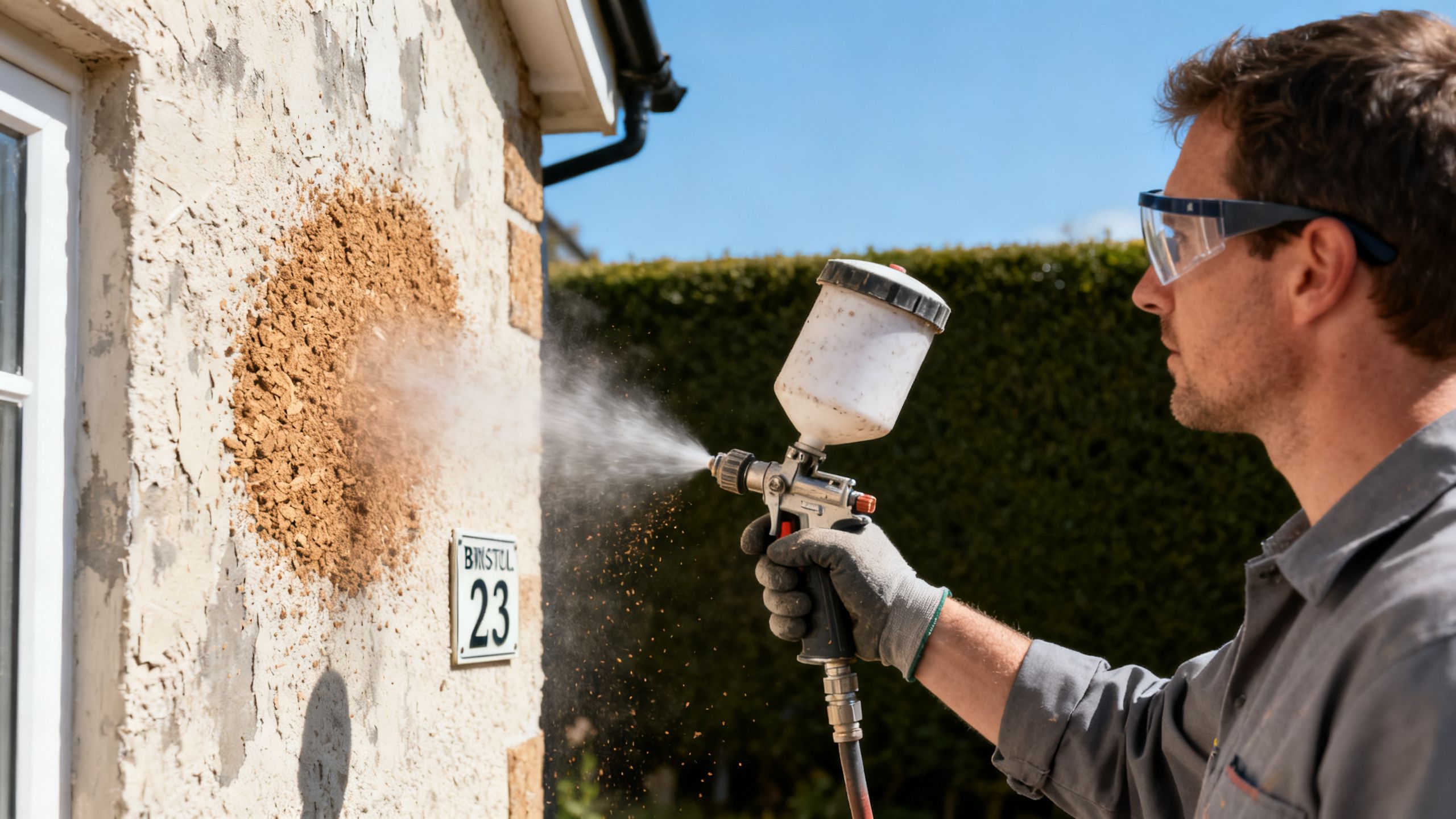
What drives the price
The same area can cost very differently depending on what is being coated and the work needed before application. These are the main factors a quote should make clear:
| Cost factor | Effect on price |
|---|---|
| Wall area (m²) | The total area sets the material and labour requirement. Larger, continuous areas often have a lower rate per m² than small jobs because setup costs are spread over more wall. |
| Interior vs exterior | Exterior work may require access equipment and more weather-resistant planning. Interior work can involve extra masking, protection and careful detailing around fixtures. |
| Access, height and scaffolding | High walls, restricted access, conservatories, extensions or difficult ground conditions can increase labour and equipment costs. Scaffolding, where required, may be quoted separately. |
| Surface condition and preparation | Cleaning, stabilising, filling cracks or removing loose material all take time. A sound, clean substrate needs less preparation than a friable, damp or uneven one. |
| Number of coats and finish | The specified build-up and texture affect material use and application time. Confirm how many coats are included and what finish is being priced. |
| Colour | Standard colours may be included in a system’s usual range, while special colours or a particular colour match may affect material cost or availability. Check this in the specification. |
| Repairing old render first | Loose or failed render may need repair or removal before coating. Spray cork should not be used to disguise an unstable substrate; repair work can add materially to the total. |
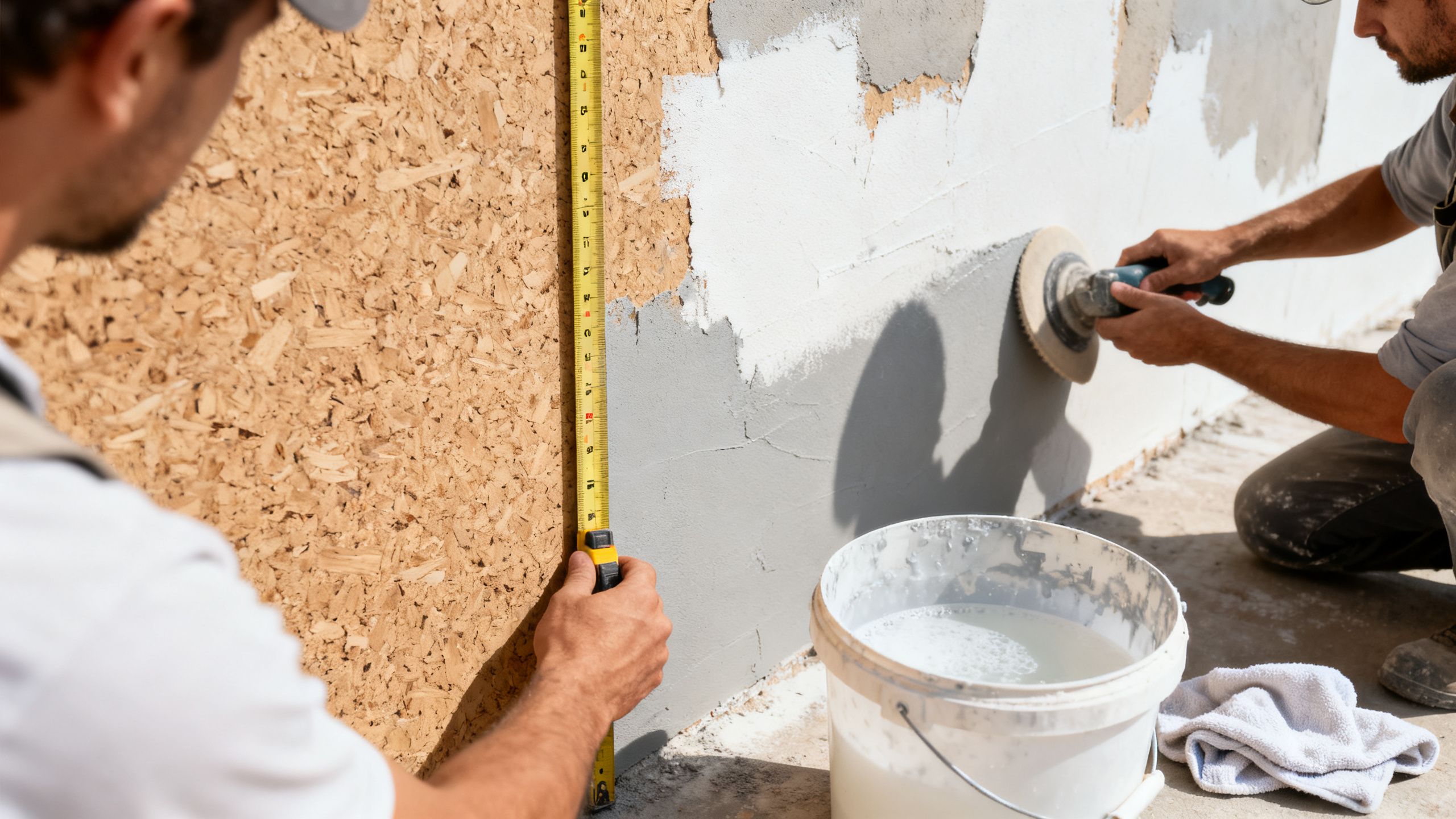
How spray cork is priced
Most contractors price spray cork per square metre, using the measured area and the agreed preparation and coating specification. A quote should identify what is included—such as protection, surface preparation, coats, access equipment and waste removal—rather than giving a rate with no explanation.
A day rate may make more sense for a very small or awkward job where measuring and pricing every square metre does not reflect the time needed for setup, masking and finishing. Small projects can also attract a minimum charge: travel, equipment setup and preparation take time regardless of whether the wall is one square metre or ten.
On larger, uninterrupted walls, the effective rate per square metre may be lower because setup and mobilisation costs are spread over more area. That does not mean the material itself necessarily gets cheaper. If a quote is substantially lower than others, check that the same preparation, number of coats, access and finish are included.
Cork vs repaint vs re-render on cost
A repaint is generally the lowest-cost option when the existing surface is sound and only needs refreshing. Spray cork costs more than a straightforward repaint because it is a specialist coating that takes more preparation and application. In return, it can provide a textured finish and some insulating benefit, and may last longer than paint when correctly specified and maintained. It is not a like-for-like substitute for repairing a failing wall.
A full re-render involves more extensive work, particularly if existing render must be hacked off, rubble removed and the masonry prepared before a new system is applied. Spray cork may be less disruptive and can be comparable to or less expensive than that type of re-render where the existing render is stable and suitable to coat. If the render is loose, damp or otherwise failing, repair or removal may still be necessary, so cork is not automatically the cheaper choice.
For a fuller explanation of the trade-offs, see our guide to spray cork versus render in Bristol. The right comparison depends on the wall’s condition and the finish it needs, not just the headline price per square metre.
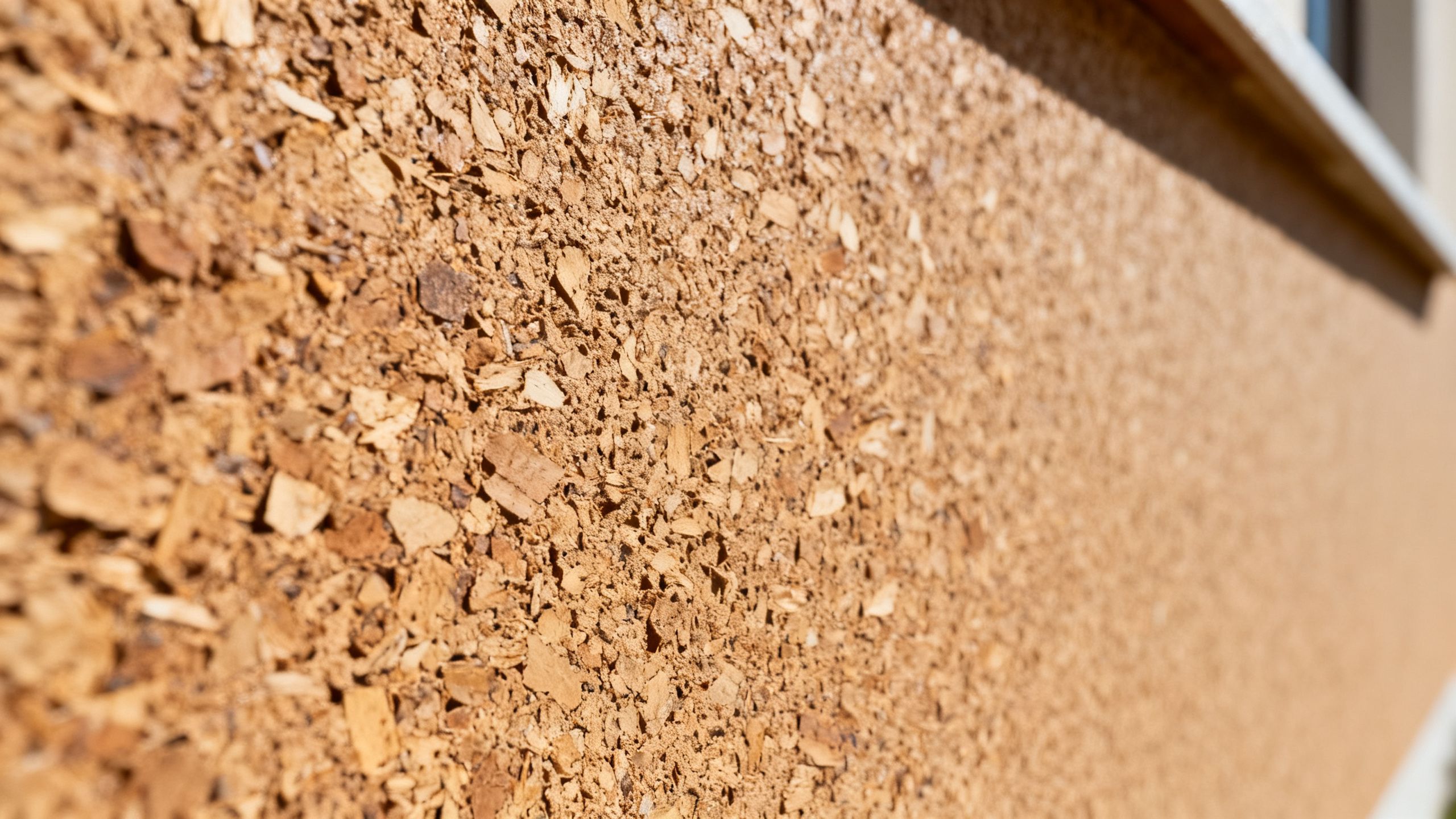
Is spray cork worth the money?
Spray cork may offer value when a homeowner wants a protective, textured coating and the existing substrate is suitable. Recycled cork in a coating system can provide an insulating contribution, but it should not be treated as a guaranteed replacement for dedicated insulation. The actual effect depends on the product build-up, wall construction and installation.
On an appropriate wall, coating over sound existing render may avoid the disruption and cost of stripping it off and starting again. Cork systems are also described as breathable, but “breathable” does not mean that a coating will solve every damp problem. The cause of moisture should be identified first, especially in Bristol’s older solid-wall homes, where moisture behaviour and unsuitable materials can be concerns. Our guide to lime render and breathable finishes in Bristol covers why the choice of system matters for older buildings.
Manufacturers may offer product warranties or guarantees, but their terms, duration and conditions differ. Ask for the specific product documentation and find out what preparation and application requirements must be met. Balance those potential benefits against the fact that spray cork is a specialist job and a newer finish in the UK market than traditional render systems. Gents Venetian Plastering & Rendering brings more than 50 years of combined plastering and rendering experience and is newly offering spray cork; that experience does not replace the need to assess each wall individually.
Getting an accurate quote
A useful quote starts with a site inspection. The plasterer should check whether the substrate is suitable, whether the existing render is sound, and whether there are signs of cracks, damp, contamination or loose material. They should measure the area, consider the height and access, and agree the required preparation, number of coats, texture and colour.
This visit matters because a photograph rarely shows whether render is firmly bonded or what preparation will be needed. It also lets the contractor identify practical costs such as scaffolding, protection for windows and paving, or repairs that should happen before coating. Ask for the proposed product system and a written breakdown of included work; that makes quotes easier to compare without assuming that the cheapest per-m² figure covers the same job.
For product-specific information, consult the CorkSol spray cork manufacturer. Manufacturer information can help explain the system, but it is not a substitute for checking that the product is suitable for your particular wall and following its application requirements.
Frequently asked questions
How much is spray cork per square metre?
As a broad, indicative UK market range, interior work may be around £40–£80 per m² and exterior work around £50–£100 per m². These are not Gents’ fixed prices or guaranteed Bristol quotes. The actual rate depends on area, preparation, access, coats and finish, so it should be confirmed after an inspection.
Is spray cork cheaper than render?
Not always. Spray cork may cost less or be comparable where sound existing render can be coated instead of stripped and replaced. If the render is failing and needs extensive repair, the cost of preparing it for cork can change the comparison. A full re-render may also be the more appropriate repair. Compare the complete scope rather than treating either material as universally cheaper.
Why can’t you give a price online?
An online estimate cannot confirm whether the substrate is suitable, how much preparation is needed or whether access equipment is required. Those details can change the price significantly. Measurements and photos can help with an initial discussion, but a firm figure needs an on-site assessment and an agreed specification.
Does preparation add much cost?
It can. A clean, stable wall may need relatively little preparation, while loose render, cracks, contamination or an uneven surface can require extra labour and materials. If old render must be repaired or removed first, that should be identified as a separate part of the quote where possible.
Is exterior spray cork more expensive than interior spray cork?
Often, but not in every case. Exterior work can involve height, scaffolding, more difficult access and weather-aware planning. Interior work may cost more than expected if the room is difficult to protect or has complicated edges and fittings. The wall’s condition and size matter for both.
Does spray cork save money in the long term?
It may offer value if its finish and insulating contribution suit the home, or if coating sound existing render avoids a more disruptive replacement. Long-term savings are not guaranteed: performance depends on the wall, product, installation and maintenance. Ask the manufacturer about warranty conditions and compare them with the expected upkeep of the alternatives.
Are there extra costs, such as scaffolding?
There may be. Scaffolding or other access equipment, repairs to existing render, extensive masking, waste removal and special colour requirements can be additional items. Ask whether each is included in the written quote, particularly for tall or hard-to-reach exterior walls.